How Could Two-Person Teams Be Protected?
MMA Duo introduces a different set of safety challenges because four fighters compete simultaneously instead of two. Each competitor must protect themselves while remaining aware of their teammate and both opposing fighters.
In a traditional MMA match, the referee generally monitors two competitors. In a 2-v-2 MMA competition, officials must monitor several exchanges that could happen at the same time.
This creates additional questions about referee positioning, fighter separation, medical supervision, protective equipment, and when a match should be stopped.
MMA Duo competitions have demonstrated that two-person team fighting is more than just a theoretical concept. However, every promotion must establish appropriate safety procedures for its particular competition format.
So how could MMA Duo fighters be protected during a 2-v-2 match?
This guide explores important safety considerations that organizers, referees, coaches, and fighters should address when developing a responsible team-based MMA competition.
1. Why Does MMA Duo Need Additional Safety Considerations?
The biggest difference between traditional MMA and MMA Duo is the number of active competitors.
In a traditional match, a referee generally monitors one fighter against another. In MMA Duo, two teammates compete against two opposing fighters simultaneously.
This creates additional situations that officials must anticipate.
Possible safety concerns include:
- Multiple simultaneous exchanges: Several striking or grappling exchanges could occur at the same time.
- Limited visibility: One fighter or referee could temporarily have difficulty seeing activity elsewhere in the competition area.
- Accidental interference: Teammates could unintentionally interfere with each other’s movements.
- Multiple injuries: More than one competitor could require medical attention during the same match.
- Fighter separation: Officials may need to intervene when competitors become entangled or move into unsafe positions.
- Delayed stoppages: A referee must recognize when a competitor can no longer defend themselves, even while another exchange is taking place.
These concerns do not mean that a 2-v-2 format cannot be organized safely. They mean that the competition needs procedures designed specifically for multiple simultaneous competitors.
Read more: How Does a 2-on-2 MMA Fight Work?
2. Should MMA Duo Use More Than One Referee?
Referee supervision is one of the most important safety considerations in a two-versus-two competition.
A single referee may have difficulty monitoring four fighters when multiple exchanges happen simultaneously.
One possible approach would be to use a lead referee supported by additional qualified officials.
Possible responsibilities could include:
- Lead referee: Maintains overall control of the match and makes official stoppage decisions.
- Supporting officials: Help monitor activity in different areas of the competition space.
- Position monitoring: Watch for unsafe grappling situations, accidental interference, and competitors who cannot defend themselves.
- Communication: Ensure officials can quickly communicate when an intervention is necessary.
The exact number of referees would depend on the competition area, format, and applicable regulations.
Additional officials should not create confusion about who has authority to stop the match. The rules must clearly identify the official responsible for controlling the contest.
Related reading: What Are the Rules of MMA Duo? Understanding 2-on-2 MMA Rules
3. What Protective Equipment Should MMA Duo Fighters Wear?
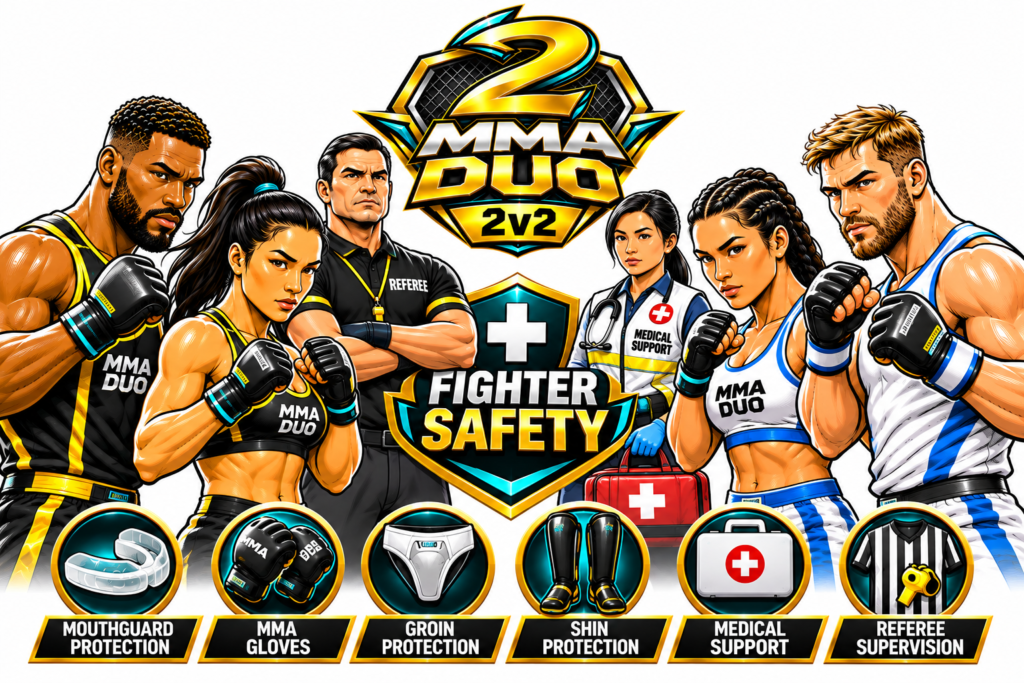
Protective equipment is another important part of fighter safety.
The equipment required will depend on whether the competition is amateur, professional, or conducted under a particular promotion’s regulations.
Common MMA protective equipment includes:
- MMA gloves: Provide hand protection while allowing fighters to grapple and perform submissions.
- Mouthguards: Help protect the teeth and reduce certain dental injuries.
- Groin protection: Helps protect against accidental contact to a sensitive area.
- Shin protection: May be required in amateur or training formats.
- Approved competition attire: Should fit properly and avoid loose material that could interfere with movement or grappling.
- Additional approved protection: May be required according to the competition’s rules and applicable regulations.
Equipment should be inspected before the competition begins.
Officials should check that gloves fit properly, mouthguards are available, and competitors are not wearing jewelry or other prohibited accessories.
Protective equipment cannot eliminate the risk of injury, but appropriate equipment and consistent inspection can help reduce preventable problems.
Read more: MMA Duo Training: How Should Two Fighters Prepare Together?
4. How Should the Competition Area Be Designed for Safety?
The competition area must provide enough room for four fighters to move without creating unnecessary hazards.
A fighting area designed for two competitors may not automatically be appropriate for four.
Organizers should consider:
- Available space: The competition area should provide sufficient room for four active fighters.
- Surface condition: The floor or mat should be appropriate for striking, wrestling, takedowns, and grappling.
- Protective boundaries: The cage, fencing, or other approved barriers should be inspected before the event.
- Clear surroundings: Equipment, cables, and other unnecessary objects should be kept away from the fighting area.
- Safe access: Medical personnel and authorized officials should be able to reach injured competitors quickly.
- Visibility: Referees and medical personnel should have clear views of the competition area.
A larger fighting area may help reduce crowding, but size alone does not guarantee safety.
The layout should be tested during supervised training before being used in an actual competition.
5. How Can Fighters Avoid Accidental Team Interference?
One challenge in MMA Duo is that teammates must compete in the same space while avoiding unnecessary interference with each other.
Two fighters may have different fighting styles and movement patterns. Without coordination, they could accidentally collide, block each other’s movements, or create unsafe situations.
Teams should develop basic movement awareness before competing.
Important considerations include:
- Spacing: Teammates should maintain enough distance to move without unnecessarily obstructing each other.
- Communication: Fighters should use simple signals and short instructions when appropriate.
- Movement awareness: Each competitor should remain aware of the positions of all three other fighters.
- Controlled transitions: Teammates should practice changing positions without creating collisions.
- Grappling awareness: Fighters should understand how their partner’s position affects nearby exchanges.
- Training discipline: Teams should practice avoiding uncontrolled movements and unnecessary interference.
These precautions should be part of regular team training rather than something fighters attempt to learn during competition.
Learn more: MMA Duo Fighter Roles: How Two Teammates Work Together
6. When Should an MMA Duo Fight Be Stopped for Medical Reasons?
Medical stoppages are essential in any combat sport.
In MMA Duo, officials may need to respond to an injured competitor while the other three fighters are still involved in the match.
A competitor should not be allowed to continue simply because their teammate remains active.
Possible reasons for a medical stoppage include:
- Knockout: A fighter loses consciousness or cannot safely continue.
- Concussion concerns: A competitor displays signs of a possible head injury or neurological impairment.
- Serious cuts: An injury affects vision or creates another significant medical concern.
- Fractures: A suspected serious bone injury makes continued participation unsafe.
- Loss of defensive ability: A fighter cannot intelligently protect themselves from further attacks.
- Medical distress: A competitor displays symptoms that require immediate professional assessment.
The referee and ringside medical personnel should have clearly defined responsibilities.
A medical professional should be able to recommend or require a stoppage under the applicable regulations when continuing would place a competitor at unacceptable risk.
The competition rules must also explain what happens to the remaining fighters when one teammate is medically removed.
7. Should an Entire MMA Duo Match Stop When One Fighter Is Injured?
This is an important question that every MMA Duo promotion should address.
In a traditional MMA match, a medical stoppage normally ends the contest between the two competitors.
A team competition introduces another situation: one fighter may be injured while the other three competitors remain physically able to continue.
Organizers could consider several approaches:
- Full match stoppage: Stop the entire competition whenever a fighter requires medical attention.
- Temporary suspension: Pause all activity while medical personnel assess the injured competitor.
- Team continuation: Allow the remaining competitors to continue only if the published rules permit it and medical and officiating authorities determine that it is safe.
- Medical termination: End the match if the injury or circumstances make continued competition inappropriate.
The safest approach would require an immediate pause when an injury needs assessment, followed by a decision under the event’s established rules.
No team should be permitted to continue attacking while an injured competitor is receiving medical attention.
The rules should also explain whether the injured fighter’s removal automatically ends the team’s participation or whether a teammate can continue.
8. Why Should MMA Duo Have Medical Personnel at Ringside?
Medical supervision is essential when organizing a combat sports event.
Because MMA Duo involves four active competitors, organizers should consider whether the medical resources available are sufficient for the possibility of multiple injuries.
Important medical preparations include:
- Qualified ringside physician: A medical professional familiar with combat sports should be available to evaluate competitors.
- Emergency medical personnel: Appropriate emergency response staff should be present.
- First-aid equipment: Medical supplies should be accessible throughout the event.
- Emergency transportation: Organizers should establish procedures for transferring an injured fighter to a medical facility.
- Pre-competition medical checks: Fighters should complete the examinations and clearances required by the applicable authority.
- Post-fight evaluations: Competitors should receive appropriate medical assessment after their matches.
Medical personnel must be able to access the competition area without unnecessary delays.
Organizers should also plan for the possibility that more than one competitor needs attention at the same time.
9. Should MMA Duo Fighters Have Pre-Fight and Post-Fight Medical Checks?
Yes. Medical evaluations before and after competition can help identify health concerns and determine whether a fighter is fit to participate.
Pre-fight requirements should follow the applicable athletic commission or sanctioning body’s regulations.
Possible checks and requirements include:
- Reviewing required medical documentation.
- Checking for visible injuries or conditions that could affect participation.
- Confirming that required medical clearances are current.
- Verifying that the fighter meets applicable competition requirements.
- Ensuring that officials know about any medical restriction that could affect participation.
After the match, fighters should be evaluated when required by the event’s medical protocols, particularly following a knockout, suspected concussion, significant injury, or medical stoppage.
A fighter should not return to training or competition until appropriately cleared under the applicable medical guidelines.
Read more: How Do You Win an MMA Duo Fight?
10. How Can MMA Duo Reduce Dangerous Situations During Competition?
MMA Duo organizers should establish procedures for situations that could become dangerous when four competitors are active simultaneously.
Possible safety measures include:
- Clear stoppage signals: All fighters and officials should recognize the signals used to stop the match.
- Immediate compliance: Fighters must stop attacking when the referee calls a halt.
- Controlled separation: Officials should establish procedures for separating competitors when necessary.
- Prohibited actions: Illegal strikes, dangerous techniques, and unsportsmanlike conduct should be clearly defined.
- Fighter protection: Competitors who are unable to defend themselves should not be subjected to unnecessary additional attacks.
- Emergency procedures: Officials should know how to respond when multiple fighters need assistance.
- Pre-event briefings: Fighters, coaches, referees, and medical personnel should understand their responsibilities.
The most important principle is that competition should stop whenever continuing creates an unacceptable safety risk.
Related reading: What Are the Rules of MMA Duo? Understanding 2-on-2 MMA Rules
11. Frequently Asked Questions About MMA Duo Fighter Safety
Is MMA Duo more dangerous than traditional MMA?
It is not possible to establish that MMA Duo is more dangerous without reliable injury data comparing the formats. However, having four active competitors creates additional officiating, positioning, and medical-response challenges.
How many referees should an MMA Duo fight have?
The appropriate number depends on the competition area and rules. A promotion could use a lead referee supported by additional officials to monitor simultaneous exchanges.
What protective equipment should MMA Duo fighters wear?
Common equipment includes approved MMA gloves, mouthguards, groin protection, and competition attire. Additional equipment requirements depend on the applicable rules and competition level.
What happens if one MMA Duo fighter gets injured?
The competition should be paused when medical assessment is necessary. The referee and medical personnel should determine the appropriate response under the event’s rules.
Can an MMA Duo match continue if one fighter is eliminated?
That depends on the competition’s published rules. Organizers must establish whether the remaining teammates can continue after a knockout, submission, or medical removal.
Does MMA Duo need more medical personnel than traditional MMA?
Organizers should assess the additional demands created by four active competitors. Medical resources should be sufficient to respond appropriately if multiple fighters require attention.
Can teammates accidentally injure each other during an MMA Duo fight?
Yes. Accidental collisions and interference are possible when teammates move in the same competition area. Coordination training, spacing, and clear rules can help reduce these risks.
Who should have authority to stop an MMA Duo fight?
The rules should clearly identify the referee’s authority and the medical professional’s authority to require a stoppage under the applicable regulations.
Conclusion: Fighter Safety Must Come First in MMA Duo
MMA Duo creates a different set of safety considerations because four competitors share the same fighting area.
Referee supervision, protective equipment, medical support, competition-area design, and coordinated movement all play important roles in protecting the fighters.
Organizers should not simply copy traditional MMA procedures without considering the additional challenges created by simultaneous team competition.
A responsible MMA Duo format needs clear safety rules, qualified officials, appropriate medical resources, and procedures for responding to injuries involving one or more competitors.
The goal should be to create a competition where teams can demonstrate their skills and teamwork without sacrificing fighter protection.
In MMA Duo, protecting all four fighters should always be more important than allowing the competition to continue.
Related reading: MMA Trio Fighter Safety: How Could Fighters Be Protected?
Visit the MMA Trio homepage to explore more articles about team-based mixed martial arts, including MMA Duo rules, training, fighter roles, and competition strategy.
Sources and Further Reading
- Unified Rules of Mixed Martial Arts: Background on MMA competition rules, prohibited actions, medical requirements, and referee responsibilities.
- California State Athletic Commission: MMA officials, unified rules, and judging criteria.
- Ontario Athletics Commission: Professional MMA rules and fighter safety requirements.
- International Mixed Martial Arts Federation: Information about MMA regulation and athlete safety.
- Western Australia Department of Local Government, Sport and Cultural Industries: Role of medical practitioners in combat sports and medical stoppages.
*Note: The safety measures discussed in this article are recommendations for a team-based competition format. They should not be interpreted as universal official MMA Duo regulations. Actual requirements depend on the promotion and governing authority.*