MMA Duo is a team-based mixed martial arts format in which two fighters compete against two opponents at the same time. Unlike traditional MMA, where one fighter faces one opponent, MMA Duo introduces another layer of competition: each athlete must manage their own fight while remaining aware of their teammate.
But what are the rules of 2 v 2 MMA Duo? How do fighters win, what happens when one competitor is eliminated, and how do referees control a match involving four athletes?
MMA Duo rules can vary depending on the promotion and event. However, organized competitions have already demonstrated a working format. One example is the MMA Duo competition introduced at LION Championship 21 in April 2025, where four fighters competed simultaneously under the supervision of two referees.
This guide explains the main rules used in that format, the safety requirements a competition needs, and the areas that should be clearly defined before any MMA Duo event.
1. How Many Fighters Compete in MMA Duo?
A standard MMA Duo matchup involves four fighters divided into two teams:
- Team A has two fighters.
- Team B has two fighters.
- All four competitors can be active in the competition at the same time.
- Each team works together while attempting to defeat the opposing team.
The two-person team format is what makes MMA Duo different from traditional one-on-one MMA.
Both teammates must understand their roles, communicate effectively, and pay attention to what is happening around them. A fighter cannot focus only on an individual opponent without considering the position and safety of their teammate.
Read more: What Is MMA Duo? Understanding 2-on-2 Mixed Martial Arts
2. Do All Four Fighters Compete at the Same Time?
In the MMA Duo format used at LION Championship 21, all four fighters competed simultaneously.
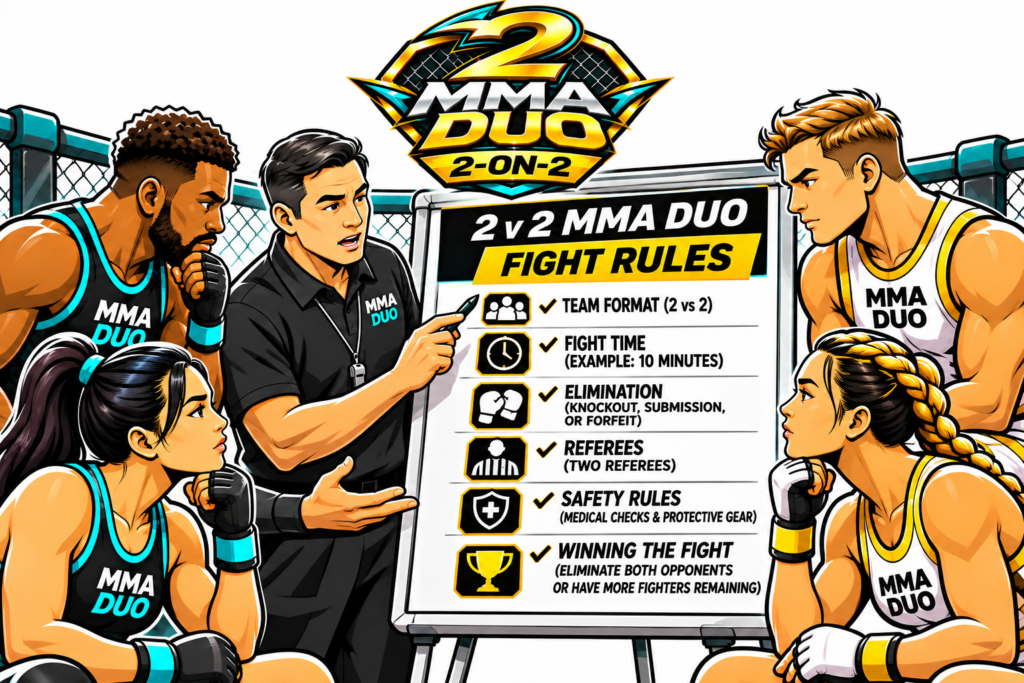
The match took place continuously over one 10-minute period, with two referees supervising the action. This created a different type of challenge from traditional MMA because each fighter had to manage an opponent while remaining aware of the second opposing fighter.
However, not every future MMA Duo promotion has to use exactly the same match structure. Organizers must publish their format before competition so athletes, coaches, officials, and spectators understand how the match will operate.
For a closer explanation of how the action unfolds, see How Does a 2-on-2 MMA Fight Work?.
3. What Happens When a Fighter Is Knocked Out or Submits?
One of the most important parts of MMA Duo is the elimination rule.
Under the format reported for LION Championship 21, a fighter could be eliminated after:
- A knockout.
- A submission or successful finishing hold.
- Voluntarily giving up or withdrawing from the contest.
When a fighter was eliminated, the match continued with the remaining teammate and the opposing team’s active fighters.
This means one team could find itself at a numerical disadvantage. For example:
- Team A begins with two fighters.
- Team B begins with two fighters.
- One Team A fighter is eliminated.
- The remaining Team A fighter must continue against both Team B fighters, subject to the event’s rules and referee control.
This is one of the defining features of the team format. Losing one fighter does not necessarily mean the entire team immediately loses.
The exact procedure for stopping the action, removing an eliminated competitor, and restarting the match must be established in the event regulations.
4. How Long Does an MMA Duo Fight Last?
Match duration depends on the competition’s rules.
At LION Championship 21, the MMA Duo contest was scheduled as one continuous 10-minute period. This differs from the familiar round structure used in many traditional MMA contests.
A promotion could adopt a different duration, but it should clearly announce:
- The total match time.
- Whether the match has rounds or one continuous period.
- Whether there are breaks.
- What happens if time expires.
- Whether the referee can stop the match for safety reasons.
A consistent time limit helps fighters prepare and allows officials to apply the rules fairly.
5. How Is the Winning Team Determined?
The winning method must be explained before the match begins.
In the LION Championship 21 format, the team with more fighters remaining after the 10-minute contest could be declared the winner. Reports also described a decision based on the team’s superior damage or overall advantage when the time limit expired.
For a clearly defined MMA Duo ruleset, organizers should explain:
- Whether a team wins by eliminating both opposing fighters.
- Whether the team with more active fighters wins when time expires.
- How officials evaluate the match if both teams have the same number of fighters remaining.
- Whether judges use scoring criteria when a decision is required.
- How a draw is handled.
These details matter because a team-based contest needs a consistent way to determine the result, especially when neither team finishes the match.
6. What Fighting Techniques Are Allowed?
MMA Duo combines techniques from different martial arts, but competitors must follow the specific rules approved for their event.
Depending on the promotion’s ruleset, permitted techniques may include:
- Punches and other legal hand strikes.
- Kicks and knee strikes where permitted.
- Takedowns and wrestling techniques.
- Grappling and positional control.
- Legal submission attempts.
- Ground fighting within the event’s restrictions.
Not every technique allowed in traditional MMA is automatically permitted in every MMA Duo competition.
For example, the rules announced for the LION Championship 2025 format included restrictions on certain kicking techniques against grounded opponents. This demonstrates why fighters cannot assume that every promotion uses identical rules.
Before competing, athletes should receive the complete event rules, including the permitted techniques for standing and grounded positions.
7. What Actions Should Be Prohibited?
MMA Duo needs clear foul rules because four competitors may be active in the same competition area.
A ruleset should address prohibited actions such as:
- Eye gouging.
- Biting.
- Hair pulling.
- Groin attacks.
- Strikes to prohibited target areas.
- Attacking after the referee has stopped the action.
- Holding the cage or using it illegally.
- Unsportsmanlike conduct.
- Interfering with an eliminated fighter.
Organizers should also explain how officials handle accidental contact between teammates. Fighters must be able to work together without deliberately endangering one another.
The rules should identify the penalties for fouls, including warnings, point deductions where applicable, disqualification, or other disciplinary action.
8. How Many Referees Are Needed?
A 2-on-2 contest creates a more complicated officiating challenge than a standard one-on-one fight.
Two referees supervised the MMA Duo match at LION Championship 21. This provides a real example of how an event can approach the challenge of monitoring four competitors.
A well-organized event should establish:
- Who has authority to stop the match.
- How referees communicate with each other.
- How an official identifies a knockout or submission.
- How eliminated fighters are removed safely.
- How accidental fouls and dangerous situations are handled.
- How the match is restarted after an interruption.
The priority must always be fighter safety. Officials need to be able to intervene quickly when a competitor can no longer defend themselves.
9. What Safety Rules Should MMA Duo Include?
Four fighters competing at the same time create additional risks. A safe competition needs clear procedures before the first match begins.
Important safety requirements include:
- Medical personnel available at ringside or cage side.
- Pre-fight medical checks.
- Appropriate gloves and protective equipment.
- Clear referee authority to stop the contest.
- Immediate attention for injured or unconscious fighters.
- Procedures for safely removing eliminated competitors.
- Medical evaluation before an injured fighter can return to competition.
- Rules against striking after a stoppage.
The event should also establish how officials respond if two fighters become entangled or if a competitor is unable to protect themselves.
Safety rules should never be treated as optional. They are a central part of making a team-based combat sport responsible and professionally organized.
10. Do MMA Duo Rules Need Weight Classes?
Weight differences can create an unfair advantage in any combat sport.
For MMA Duo, organizers may consider the combined weight of both fighters on each team rather than looking only at individual weight. This approach was included in the format planning announced for LION Championship 2025.
A competition should explain:
- Whether teams are matched by combined weight.
- Whether individual weight limits also apply.
- How weigh-ins are conducted.
- What happens if a fighter misses weight.
- Whether replacement fighters are permitted.
- How teams are matched fairly.
The rules should be published before registration, so teams know the requirements.
11. Can an MMA Duo Team Replace an Injured Fighter?
Substitution rules must be established before a competition begins.
A promotion may decide that teams cannot replace a fighter once a match starts. Alternatively, an event could permit replacements under specific conditions before competition begins.
For example, organizers may establish a deadline for submitting a replacement if an athlete is injured before the event.
However, allowing a new fighter to enter after the match has started would significantly change the competition. Any such rule would need to be clearly defined and applied equally to both teams.
12. Are There Official Rules for Every MMA Duo Competition?
There is no single universal ruleset that automatically governs every MMA Duo event.
The rules used by one promotion may differ from those adopted by another. Match duration, permitted techniques, elimination procedures, judging criteria, weight requirements, and referee responsibilities can all vary.
The MMA Duo competition at LION Championship 21 provides a real example of an organized 2-on-2 format. Its published rules included simultaneous competition, a 10-minute match, fighter elimination, and a team-based result.
Other promotions should publish their own regulations and make them available to athletes and officials before competition.
This distinction is important: MMA Duo is an established competition format, but the rules of a particular event should not be assumed to apply to every organization.
Frequently Asked Questions About MMA Duo Rules
What are the basic rules of 2 v 2 MMA Duo?
Two fighters compete as a team against two opposing fighters. In the LION Championship 21 format, all four fighters competed simultaneously, and a competitor could be eliminated by knockout, submission, or withdrawal.
Can two fighters attack one opponent in MMA Duo?
The format involves two-person teams, but the exact rules governing simultaneous engagement and multiple-opponent situations must be defined by the event organizer. Fighters must follow the referee’s instructions and all safety restrictions.
Does a team lose when one fighter is knocked out?
Not necessarily. Under the LION Championship 21 format, the remaining teammate continued competing against the opposing team’s active fighters.
How long is a 2-on-2 MMA fight?
The LION Championship 21 MMA Duo contest used one continuous 10-minute period. Other promotions may establish a different match duration.
How many referees are needed for MMA Duo?
LION Championship 21 used two referees. The number and positioning of officials should be determined by the competition organizer based on the rules and safety requirements.
Are MMA Duo rules the same as traditional MMA rules?
Not necessarily. MMA Duo may use familiar MMA techniques, but team-based elimination, simultaneous competition, match duration, and other procedures can be different.
Conclusion: Clear Rules Are Essential for MMA Duo
MMA Duo introduces a different approach to mixed martial arts by bringing two-person teams into the same competition. Its rules must account for simultaneous action, fighter elimination, team-based results, referee coordination, and additional safety considerations.
Organized competition has already demonstrated that a 2-on-2 format can be conducted under a defined ruleset. The next step for any promotion is to establish consistent regulations that athletes, coaches, referees, and fans can understand.
To learn more about the format, visit the MMA Trio homepage and explore the related articles covering team fighting, strategy, and competition.
Related reading: MMA Trio Substitutions: Should Teams Be Allowed to Replace Fighters?
Related reading: MMA Trio Weight Classes: How Could Teams Be Matched Fairly?
Read more: MMA Trio Fighter Safety: How Could Fighters Be Protected?
Related reading: MMA Trio Referees and Safety: How Could Officials Control a 3-on-3 Fight?
Read more: MMA Trio Fouls: What Actions Should Be Prohibited?
Related reading: MMA Trio Scoring: How Could a 3-on-3 Fight Be Judged?
Sources and further reading: