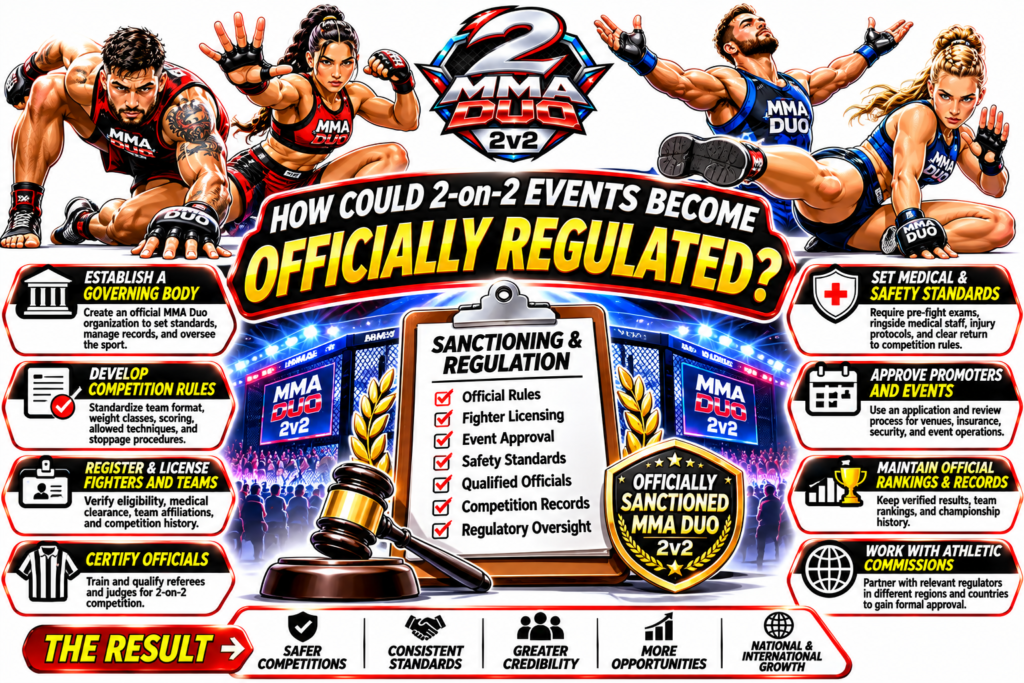
How Could 2-on-2 Events Become Officially Regulated?
Introduction: What Would It Take for MMA Duo to Become a Regulated Sport?
As team-based mixed martial arts continues to attract interest, an important question arises: how could MMA Duo establish formal regulatory oversight and become an organized, recognized competition format?
Sanctioning could play an important role in the long-term development of 2-on-2 mixed martial arts.
In combat sports, sanctioning organizations and athletic commissions help establish competition requirements, oversee events, review fighter eligibility, and enforce applicable safety standards.
For MMA Duo, developing a regulatory structure could help create consistency between competitions, build confidence among athletes, and make it easier for promoters, gyms, sponsors, and event organizers to participate.
However, regulating a two-person fighting format could introduce additional challenges because two athletes compete as teammates rather than as completely independent competitors.
This article explores how MMA Duo could develop a formal sanctioning structure, work with regulatory organizations, establish licensing procedures, and create consistent standards for organized 2-on-2 competitions.
1. What Is Combat Sports Sanctioning?
Combat sports sanctioning is the process through which an authorized organization oversees or approves competitions according to established requirements.
Depending on the jurisdiction and the organization involved, sanctioning can include:
– Reviewing event applications.
– Establishing competition requirements.
– Verifying fighter eligibility.
– Approving officials.
– Reviewing safety procedures.
– Monitoring compliance.
– Maintaining competition records.
– Reviewing event results.
In some locations, government athletic commissions regulate professional combat sports directly.
In other situations, recognized sporting organizations or sanctioning bodies may have specific responsibilities under applicable laws and agreements.
For MMA Duo, the goal would be to establish a clear regulatory framework that explains who oversees competitions and what standards participating organizations must follow.
Sanctioning would not automatically make the format officially recognized everywhere. Regulatory authority and recognition would depend on the relevant jurisdiction and its legal requirements.
2. Establishing an MMA Duo Governing Organization
One possible development would be establishing a dedicated MMA Duo governing organization.
This organization could provide centralized administration and help coordinate competition standards between participating promoters, teams, and sporting organizations.
Potential responsibilities could include:
– Maintaining official MMA Duo competition standards.
– Developing standardized event procedures.
– Establishing fighter registration requirements.
– Maintaining team and athlete records.
– Publishing official competition information.
– Developing referee and official qualification standards.
– Coordinating with regulatory authorities.
– Reviewing proposed rule changes.
The organization could also establish a formal process for approving competitions that voluntarily participate in its framework.
A governing organization would need transparent leadership, written policies, clear responsibilities, and procedures for handling disputes.
It would also need to respect the authority of government regulators in each location where competitions take place.
3. Working With Athletic Commissions
Athletic commissions could become important partners in the development of regulated MMA Duo competitions.
In jurisdictions where commissions oversee professional mixed martial arts, organizers would need to determine whether existing regulations cover the proposed 2-on-2 format.
Some existing regulatory requirements might apply, while other aspects could require additional review or approval.
Potential areas of cooperation could include:
– Event authorization.
– Fighter licensing.
– Medical requirements.
– Official appointments.
– Venue inspections.
– Competition supervision.
– Results reporting.
– Post-event documentation.
MMA Duo organizers could present a detailed explanation of how the two-person competition format operates.
This could help regulators evaluate the format and determine whether existing rules are sufficient or whether additional requirements would be necessary.
4. Creating Standardized MMA Duo Competition Regulations
A consistent regulatory framework would help competitions operate under predictable requirements.
Different promoters should not have completely different interpretations of fundamental competition procedures.
A standardized framework could address:
– Team composition.
– Fighter eligibility.
– Weight divisions.
– Competition duration.
– Approved techniques.
– Scoring procedures.
– Referee responsibilities.
– Team substitutions, if permitted.
– Stoppage procedures.
– Disqualification requirements.
– Appeals and protests.
Special attention would be necessary for situations involving two fighters competing simultaneously.
For example, regulations would need to explain how officials respond when one fighter is incapacitated while the teammate remains active.
They would also need to address situations where one athlete commits a violation that affects the other competitor.
These provisions could help create a consistent regulatory foundation.
For additional information about the competition format, read What Is MMA Duo? Understanding 2-on-2 Mixed Martial Arts.
5. Developing Fighter Registration and Licensing
Athlete registration could become an important part of an organized MMA Duo system.
A centralized registration process could help identify competitors, verify records, and maintain accurate information about participating athletes.
Depending on local regulatory requirements, professional fighters might also need licenses issued by the appropriate government authority.
Potential registration information could include:
– Legal identification.
– Competition history.
– Weight division.
– Team affiliation.
– Medical clearance documentation.
– Relevant fight records.
– Suspension information.
– Licensing status.
Team registration could also be introduced.
Each team could receive an official identification number connecting its members, competition history, and results.
However, an MMA Duo organization would not replace government licensing authorities where those licenses are legally required.
6. Establishing Official Weight Classes
Weight classifications would need careful consideration in a two-person competition format.
A regulatory organization could examine several possible approaches.
These could include:
– Individual weight limits for each fighter.
– Maximum combined team weight.
– Separate team divisions based on combined weight.
– Individual weight differences within an approved team limit.
– Additional requirements for specific competition formats.
For example, a team could consist of two athletes whose combined weight falls within an approved division.
Alternatively, each fighter could have an individual weight limit.
The appropriate system would depend on the competition format, athlete safety considerations, and regulatory approval.
Standardized weigh-in procedures could also help ensure that participating teams meet their assigned requirements.
7. Certifying Referees and Competition Officials
Regulated MMA Duo competitions would require officials who understand both individual mixed martial arts and team-based competition procedures.
Officials would need to recognize situations that are unique to simultaneous two-person competition.
Potential certification requirements could include:
– Knowledge of approved competition rules.
– Understanding team-based scoring.
– Recognizing illegal techniques.
– Managing simultaneous exchanges.
– Identifying fighter injuries.
– Coordinating referee communication.
– Understanding stoppage procedures.
– Maintaining accurate competition records.
Additional officials might be necessary depending on the competition format.
A dedicated training and certification program could help establish consistent officiating standards.
For a closer look at this subject, read MMA Duo 2-v-2 Referees: How Could Officials Control a 2-on-2 Fight?
8. Establishing Medical and Fighter Safety Requirements
Athlete protection would be one of the most important considerations when developing a regulated competition system.
Two-person competitions could create situations that require careful medical supervision because multiple exchanges may occur simultaneously.
A regulatory framework could establish requirements involving:
– Pre-competition medical examinations.
– Ringside physicians.
– Emergency medical personnel.
– Ambulance availability.
– Post-competition medical assessments.
– Concussion evaluation procedures.
– Medical suspensions.
– Return-to-competition requirements.
– Emergency evacuation procedures.
Medical professionals would also need clear authority to recommend or require that a competition be stopped when necessary.
Both members of a team would need individual medical assessments.
An injury to one athlete should not prevent officials from properly evaluating the other athlete.
Safety requirements would need to be reviewed by qualified medical professionals and applicable regulatory authorities.
Read more: MMA Duo 2-v-2 Fighter Safety: How Could Two-Person Teams Be Protected?
9. Approving Promoters and Event Organizers
A formal sanctioning system could establish requirements for promoters who want to organize MMA Duo competitions.
Rather than allowing every organizer to operate under different standards, an approval process could help maintain consistency.
Potential promoter requirements could include:
– Business registration.
– Event applications.
– Proof of financial responsibility.
– Venue information.
– Insurance documentation.
– Medical staffing arrangements.
– Official appointments.
– Security arrangements.
– Emergency response planning.
– Compliance with applicable laws.
Promoters could also be required to submit competition schedules, team information, and event results.
A transparent approval process could help establish confidence among athletes, spectators, sponsors, and other organizations.
10. Developing Official MMA Duo Rankings
An organized sport benefits from reliable competition records and rankings.
MMA Duo could eventually introduce an official ranking system for participating teams.
Potential ranking categories could include:
– Overall team rankings.
– Weight division rankings.
– Tournament rankings.
– Regional rankings.
– Individual fighter records.
– Championship rankings.
A ranking system would need clearly defined criteria.
For example, teams could earn ranking points based on approved competition results, tournament performances, and other published criteria.
The organization would also need procedures for handling inactive teams, disqualifications, disputed results, and changes in team membership.
Transparent rankings could help fans follow the development of competing teams and give athletes measurable competition goals.
11. Establishing Rules for Disputes and Appeals
Regulated competitions need procedures for handling disagreements.
In a team-based format, disputes could involve more than one athlete or a decision that affects the entire team.
Potential disputes could concern:
– Scoring decisions.
– Referee stoppages.
– Rule violations.
– Disqualification decisions.
– Fighter eligibility.
– Weight requirements.
– Competition results.
– Team registration.
A formal appeals process could establish how complaints are submitted, reviewed, and resolved.
The process could include written submissions, supporting evidence, review deadlines, and decisions issued by authorized officials.
Not every competition decision would necessarily be eligible for appeal.
Clear procedures would help prevent inconsistent decisions and improve confidence in the competition system.
12. Insurance and Financial Responsibility
Insurance and financial responsibility could become important requirements for regulated MMA Duo events.
Promoters would need to understand their obligations under local laws and any applicable sanctioning agreements.
Potential insurance considerations could include:
– Event liability insurance.
– Participant accident coverage.
– Venue insurance requirements.
– Workers’ compensation where applicable.
– Professional liability coverage.
– Equipment and property coverage.
The precise coverage required would depend on the location, event structure, and applicable regulations.
A sanctioning organization could establish minimum insurance documentation requirements for participating promoters where legally appropriate.
13. Creating a Transparent Competition Record System
An organized regulatory structure could maintain a centralized database of participating fighters, teams, competitions, and official results.
This could make it easier to verify competition histories and maintain accurate records.
Potential database information could include:
– Registered fighters.
– Registered teams.
– Competition dates.
– Approved event locations.
– Match results.
– Tournament standings.
– Official rankings.
– Suspensions.
– Disqualifications.
– Championship records.
Accurate records could help promoters, athletes, journalists, and fans obtain reliable competition information.
The system would also need appropriate privacy and data protection procedures.
14. Expanding Sanctioning Partnerships Internationally
If MMA Duo develops across multiple markets, its regulatory framework would need to accommodate different legal systems.
Combat sports regulations are not identical everywhere.
A competition that is permitted under one jurisdiction’s rules may require additional authorization in another location.
An international development strategy could involve:
– Identifying relevant local regulatory authorities.
– Reviewing local combat sports legislation.
– Establishing relationships with recognized sporting organizations.
– Working with qualified local promoters.
– Developing translated regulatory documents.
– Creating consistent international competition standards.
– Establishing procedures for transferring competition records.
A central organization could maintain the overall competition framework while respecting the authority of local regulators.
This approach could help create consistency without assuming that one regulatory approval automatically applies worldwide.
15. How Could MMA Duo Work Toward Formal Recognition?
Formal recognition would likely require a gradual development process.
A possible pathway could involve several stages.
– Establish a clearly defined competition format.
– Develop comprehensive written regulations.
– Create an organizational structure.
– Establish fighter and team registration procedures.
– Develop official training and certification standards.
– Consult qualified legal and medical professionals.
– Approach relevant athletic commissions.
– Identify jurisdictions willing to review the format.
– Organize competitions under applicable approvals.
– Maintain transparent competition records.
– Expand regulatory relationships as opportunities develop.
The process could take time.
Recognition would depend on the relevant authorities, the legal framework, and whether the proposed competition format satisfies applicable requirements.
Establishing an organization or publishing a rulebook alone would not make MMA Duo an officially recognized sport.
16. What Challenges Could MMA Duo Face When Seeking Regulation?
Developing a regulatory framework for a team-based fighting format could present several challenges.
Potential obstacles include:
– Existing regulations may not specifically address simultaneous 2-on-2 competition.
– Athletic commissions may require additional safety information.
– Officials may need specialized training.
– Medical procedures may need to accommodate multiple active competitors.
– Insurance providers may require additional risk assessments.
– Promoters may face different licensing requirements.
– International regulations may vary significantly.
– Establishing consistent competition records could require investment.
Another challenge would be explaining the format to organizations accustomed to regulating individual combat sports competitions.
MMA Duo would need to demonstrate how its team-based structure operates and how potential risks could be managed.
Careful planning, professional oversight, and cooperation with regulators could help address these challenges.
Frequently Asked Questions About MMA Duo Sanctioning
What does sanctioning mean in MMA?
Sanctioning generally refers to the authorization or oversight of competitions by an organization or regulatory authority that establishes applicable competition requirements and procedures.
Does MMA Duo need its own governing body?
A dedicated governing organization could help coordinate rules, registrations, competition records, and standards. However, it would still need to work within the authority of applicable government regulators.
Could athletic commissions regulate 2-on-2 MMA fights?
Potentially, depending on the jurisdiction and its legal framework. Commissions would need to determine whether existing regulations cover the format or whether additional approval and requirements are necessary.
Would MMA Duo fighters need individual licenses?
In jurisdictions requiring professional combat sports licenses, participating fighters could need individual licenses from the appropriate authority.
Could MMA Duo establish official team rankings?
Yes. A governing organization could develop a transparent ranking system based on approved competition results, tournament performances, and published ranking criteria.
Would sanctioning make MMA Duo officially recognized worldwide?
No. Regulatory approval in one jurisdiction would not automatically establish recognition in other countries or regions. Each location would have its own legal and regulatory requirements.
Why is sanctioning important for the future of MMA Duo?
A clear regulatory framework could improve consistency, establish competition standards, support athlete protection, and make it easier for promoters and sporting organizations to organize events responsibly.
Conclusion: Could Regulation Help Establish the Future of MMA Duo?
Sanctioning could become an important step in the long-term development of organized 2-on-2 mixed martial arts.
A dedicated governing organization, standardized competition regulations, fighter registration, qualified officials, medical requirements, and cooperation with athletic commissions could help create a more consistent competition structure.
However, developing a formal regulatory system would require more than creating an organization or publishing competition rules.
It would require professional oversight, transparent procedures, regulatory cooperation, and compliance with the laws governing combat sports in each location.
The opportunity for MMA Duo would be to develop a framework that recognizes the unique characteristics of team-based fighting while maintaining appropriate standards for athletes, officials, promoters, and spectators.
To learn more about MMA Duo, its competition format, rules, teams, and future development, visit the official MMA Duo website.