Scoring a 2-v-2 MMA Duo fight is different from judging a traditional mixed martial arts match. Instead of evaluating only one fighter against another, officials must consider how two teammates perform together against two opponents.
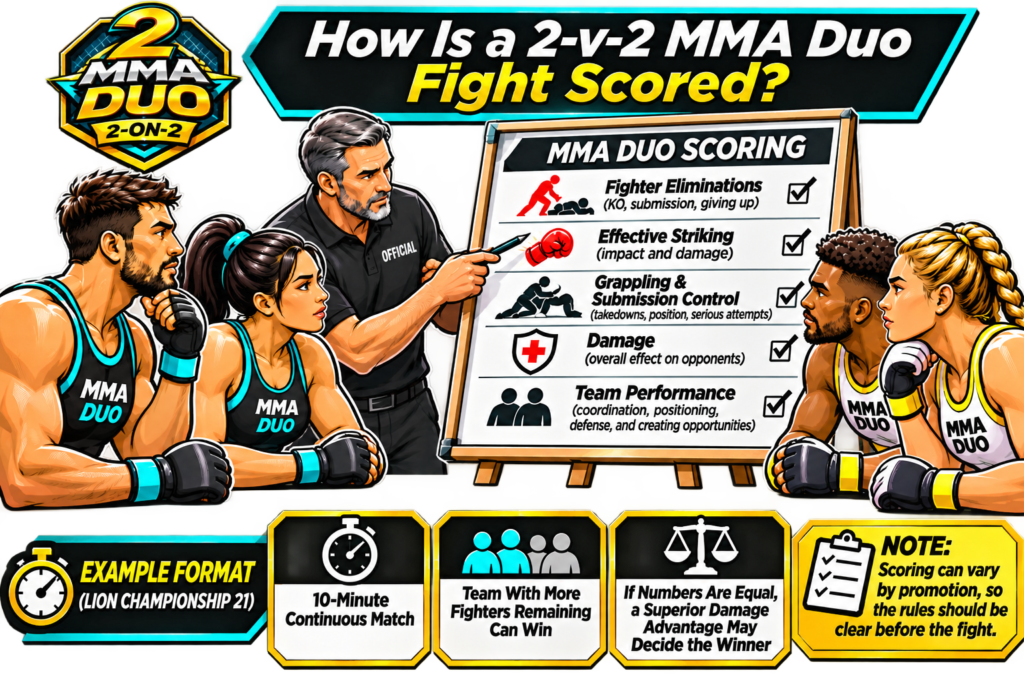
Judges and referees may need to evaluate fighter eliminations, effective strikes, grappling, damage, and the number of competitors remaining when time expires. The exact scoring method depends on the competition’s published rules.
At LION Championship 21 in April 2025, MMA Duo used a continuous 10-minute format. If the match reached the time limit, the team with more fighters remaining or a superior damage advantage could be declared the winner. This provides a real example of how team-based results can be determined.
But how should judges score a 2-v-2 MMA Duo fight? This guide explains the documented competition format, possible judging criteria, and how organizers could create a consistent scoring system.
1. How Does Scoring Work in MMA Duo?
MMA Duo is a team competition in which two fighters compete simultaneously against two opposing fighters. The result depends on the performance of the entire team, not simply one individual matchup.
Unlike traditional MMA, where judges commonly score individual rounds using a points system, an MMA Duo competition may use team-based winning conditions.
Depending on the event’s rules, officials may consider:
- Fighter eliminations: How many opposing fighters have been removed from the contest.
- Remaining team members: How many active fighters each team has when the time limit expires.
- Damage: The effective damage inflicted on opposing fighters.
- Striking and grappling: The effectiveness of legal offensive techniques.
- Overall team performance: How effectively the two teammates compete together.
Not every promotion will use all these factors. The scoring criteria must be established before the competition begins.
Read more: How Does a 2-on-2 MMA Fight Work?
2. What Scoring Method Did LION Championship 21 Use?
LION Championship 21 introduced an MMA Duo format in which all four fighters competed on the mat at the same time during one continuous 10-minute period.
Under the published format:
- A fighter could be eliminated after a knockout, submission or giving up.
- The match continued with the remaining teammate and the active members of the opposing team.
- When the 10-minute period ended, the team with more fighters remaining could win.
- If the remaining numbers did not establish an advantage, a superior damage advantage could determine the winning team.
This approach made the number of remaining fighters and the damage inflicted important parts of the final result.
It is important to understand that this was the format described for LION Championship 21. It should not be treated as a universal scoring system for every MMA Duo competition.
Related reading: What Are the Rules of 2 v 2 MMA Duo?
3. Should Fighter Eliminations Count Toward the Team Score?
Fighter eliminations are one of the most important features of a team-based MMA competition.
When one fighter is eliminated, the opposing team loses an active competitor. This can create a numerical advantage that changes the direction of the entire match.
For example:
- Both teams begin with two active fighters.
- Team A eliminates one member of Team B.
- Team A now has two active fighters against one.
- The remaining Team B fighter must continue under the event’s rules.
A scoring system could recognize eliminations as a major team achievement. However, organizers must explain whether an elimination automatically determines the winner or simply affects the final team result.
In the LION Championship 21 format, eliminating one fighter did not automatically end the entire match. The remaining competitors continued.
4. How Should Judges Evaluate Effective Striking?
Effective striking is an important consideration in traditional MMA judging and could also be relevant to an MMA Duo scoring system.
Judges could evaluate the impact of legal strikes rather than simply counting how many punches or kicks a fighter throws.
Possible considerations include:
- Clean strikes that visibly affect an opponent.
- Legal combinations that create meaningful damage.
- Strikes that force an opponent to defend or change position.
- Effective counters and offensive responses.
- Striking that creates an opportunity for a teammate.
A fighter who throws many ineffective strikes should not automatically receive more credit than an opponent who lands fewer but more effective attacks.
In a team competition, judges would also need to consider the combined effectiveness of both teammates if the rules use team-based scoring.
5. Does Grappling and Submission Control Affect Scoring?
Yes, effective grappling could be an important part of evaluating an MMA Duo match.
Grappling involves more than holding an opponent on the ground. Judges may need to consider whether a fighter’s actions create meaningful offensive progress or a realistic opportunity to finish the contest.
Possible judging considerations include:
- Successful takedowns that create an advantageous position.
- Effective positional control that leads to offensive opportunities.
- Submission attempts that seriously threaten an opponent.
- Escapes and reversals that change the position of the contest.
- Grappling actions that contribute to an opponent’s elimination.
Simply maintaining a position without meaningful offensive progress should not necessarily outweigh effective attacks from the opposing team.
In an MMA Duo match, grappling also creates additional challenges because a fighter must remain aware of the other competitors while engaging an opponent.
6. How Should Damage Be Evaluated?
Damage can be an important factor when determining which team performed better, especially if both teams have the same number of active fighters remaining.
Judges could evaluate the effects of legal striking and grappling rather than relying only on visible injuries.
Possible indicators include:
- Visible injuries caused by legal techniques.
- Knockdowns or significant offensive moments.
- Strikes that noticeably affect an opponent’s ability to continue effectively.
- Submission attempts that create a serious threat.
- Grappling actions that reduce an opponent’s ability to defend or compete.
Damage should be assessed carefully. A visible injury does not automatically prove that one team performed better throughout the match.
For a team-based format, judges would need clear instructions on how to compare the combined damage inflicted by both teammates against the damage received by their team.
7. Does Teamwork Count When Scoring an MMA Duo Fight?
Teamwork is central to MMA Duo, but organizers must decide how it should affect the official result.
Two fighters may have excellent individual skills but struggle to work together. Another team may coordinate its movements, protect its teammates, and create more effective offensive opportunities.
Possible team-performance considerations include:
- Coordination: Whether teammates work effectively together.
- Positioning: Whether fighters maintain awareness of both opponents.
- Defensive support: Whether teammates help prevent dangerous situations.
- Offensive opportunities: Whether one fighter creates openings that benefit the other.
- Energy management: Whether the team maintains effective performance throughout the match.
However, teamwork should not become an excuse to reward activity without effective results. If a promotion includes teamwork in its scoring criteria, it should define exactly what judges are expected to recognize.
8. What Happens If Both Teams Have the Same Number of Fighters Remaining?
This is one of the most important scoring situations in MMA Duo.
Imagine both teams begin with two fighters and each team loses one competitor before the time limit expires.
- Team A has one active fighter remaining.
- Team B has one active fighter remaining.
- Neither team has a numerical advantage.
In the LION Championship 21 format, a superior damage advantage could determine the winner when the remaining numbers did not establish a clear advantage.
Other promotions could adopt a more detailed judging procedure. For example, judges could compare effective striking, grappling, damage, and other clearly defined criteria.
The important point is that the rules should explain how officials determine the result before the teams enter the competition.
9. Should MMA Duo Use the Traditional 10-Point Must System?
Traditional MMA commonly uses the 10-point must system, in which judges score individual rounds. The fighter who wins a round normally receives 10 points, while the opponent receives 9 or fewer depending on the round’s competitiveness.
However, MMA Duo presents a different challenge because two teammates compete together against two opponents.
A promotion could consider adapting traditional MMA judging principles to evaluate the combined performance of each team. But it would need to establish how individual performances are combined into one team score.
For example, judges might evaluate:
- Effective striking by both teammates.
- Effective grappling and submission attempts.
- Significant damage inflicted by the team.
- Dominant offensive performance.
- Which team controlled the pace and position of the contest.
This would be a proposed team-scoring adaptation, not an established universal MMA Duo rule.
Traditional MMA judging criteria can provide a useful reference, but a team format requires additional instructions so that judges evaluate both teammates consistently.
10. What Should an Official MMA Duo Scoring System Include?
A consistent scoring system would help fighters, coaches, referees, judges, and fans understand how the winner is determined.
A promotion developing its own MMA Duo rules should clearly establish:
- Elimination rules: Which actions remove a fighter from the match.
- Time limits: How long the match lasts and what happens when time expires.
- Remaining fighters: Whether the team with more active competitors automatically wins.
- Damage evaluation: How judges compare the damage inflicted by each team.
- Judging criteria: How striking, grappling, and effective offense are evaluated.
- Tie-breaking procedures: How officials determine a winner if the teams remain even.
- Referee authority: How eliminations, medical stoppages, and rule violations are handled.
These rules should be published before competition begins. Clear instructions can reduce disagreements and help ensure that both teams are judged fairly.
11. Frequently Asked Questions About MMA Duo Scoring
How is a 2-v-2 MMA Duo fight scored?
The scoring method depends on the promotion’s rules. A competition may consider fighter eliminations, the number of active fighters remaining, damage, and effective team performance.
Does MMA Duo use the traditional 10-point scoring system?
Not necessarily. Traditional MMA uses the 10-point must system, but MMA Duo may use team-based winning conditions. Each promotion must publish its scoring rules.
What happens if both teams have one fighter remaining?
The event’s judging criteria may determine the winner. In the LION Championship 21 format, a superior damage advantage could decide the result when the remaining numbers did not establish an advantage.
Does a knockout count toward the team score?
A knockout can eliminate an opposing fighter and create a numerical advantage for the other team. The exact effect on the final result depends on the competition’s rules.
Do judges consider teamwork in MMA Duo?
A promotion could include team coordination and effective teamwork in its judging criteria. However, these factors must be clearly defined rather than assumed to be part of every MMA Duo scoring system.
Can a team win without knocking out both opponents?
Yes. Under the LION Championship 21 format, a team could win by having more fighters remaining when the 10-minute period ended or by having a superior damage advantage when the remaining numbers did not establish a winner.
Is there one official MMA Duo scoring system?
There is no universal scoring system established for every MMA Duo competition. Individual promotions and governing organizations must define the rules used for their events.
Conclusion: MMA Duo Needs Clear and Consistent Team Scoring
Scoring a 2-v-2 MMA Duo fight requires officials to evaluate more than individual fighting ability. They must understand how eliminations, effective striking, grappling, damage, and team performance affect the overall result.
LION Championship 21 demonstrated one approach by using a 10-minute team competition in which the number of fighters remaining and damage advantage could determine the winner.
Other promotions may develop different systems, including adapted MMA judging criteria or more detailed team-based scoring. Whatever method is chosen, the rules should be clear, consistent, and available to everyone before the competition begins.
In MMA Duo, the goal is not simply to score points as an individual. It is to help your team perform better than the opposing team.
Visit the MMA Trio homepage to explore more articles about team-based mixed martial arts, including MMA Duo rules, strategy, and competition formats.
Related reading: MMA Trio Referees and Safety: How Could Officials Control a 3-on-3 Fight?
Related reading: MMA Trio Draws and Tie-Breakers: How Could a Winner Be Decided?
Read more: MMA Trio Teamwork: Why Communication Could Decide a Fight