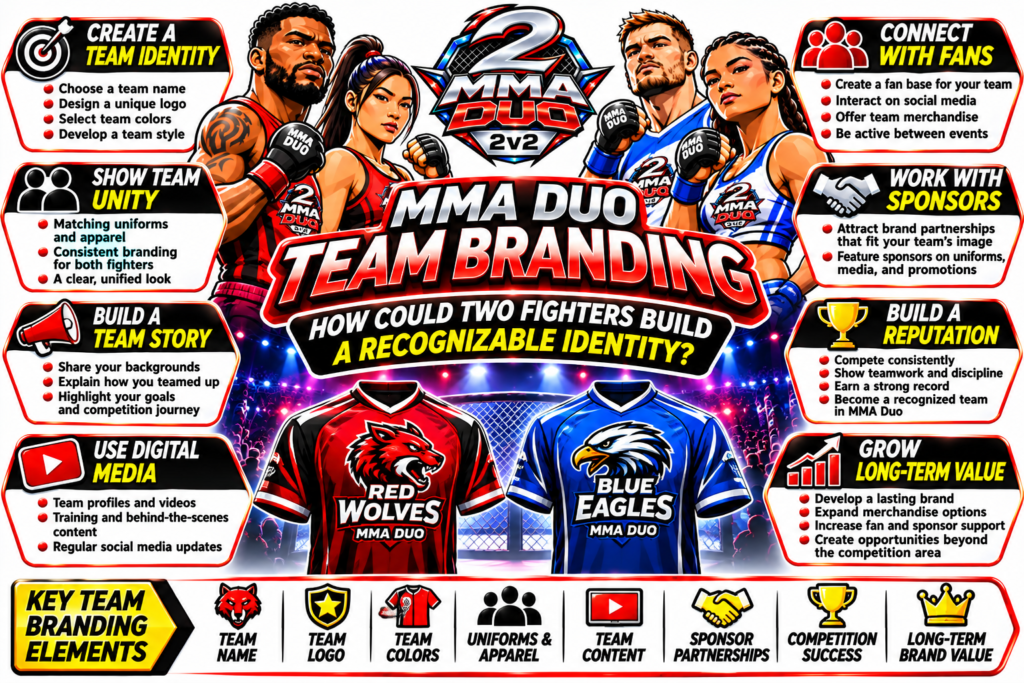
How Could Two Fighters Build a Recognizable Identity?
Introduction: Why Team Identity Matters in MMA Duo
What makes a two-person fighting team recognizable?
In traditional individual combat sports, fans often identify competitors by their names, appearances, fighting styles, and accomplishments. MMA Duo introduces another opportunity: building a recognizable identity around two fighters competing together as a team.
A strong team identity could help spectators recognize competitors, remember their names, follow their progress, and develop loyalty toward particular teams.
Team branding could involve much more than selecting matching uniforms. It could include team names, logos, colors, graphics, fighter personalities, promotional materials, and a consistent visual identity across competitions and digital platforms.
For MMA Duo, recognizable team branding could help establish individual team personalities while creating a consistent identity for the overall sport.
This article explores how two fighters could build a professional team identity and how branding could help supporters recognize and connect with their favorite competitors.
1. Create a Memorable Team Name
A team name is one of the first elements of a recognizable identity.
The name should be easy to pronounce, remember, display, and associate with the two fighters.
Possible approaches include:
– Names inspired by strength and determination.
– Names connected to the fighters’ hometowns.
– Names reflecting a particular fighting philosophy.
– Names representing a shared background.
– Original names created specifically for the team.
– Names that communicate the team’s personality.
A memorable name could help distinguish one team from every other competing pair.
For example, spectators might remember a team by its name rather than having to remember two separate fighter names.
The name should also be suitable for use on uniforms, logos, merchandise, promotional materials, and social media accounts.
Before adopting a name, organizers and teams should check for existing trademarks, business names, and conflicting branding.
2. Design an Official Team Logo
A team logo could become the visual centerpiece of an MMA Duo identity.
The logo should communicate the team’s personality while remaining easy to recognize at different sizes.
Potential logo elements include:
– Team initials.
– Original symbols.
– Geometric designs.
– Animal imagery.
– Distinctive typography.
– Team names.
– Championship-inspired graphics.
– Sport-related visual elements.
A good logo should work on uniforms, shirts, posters, social media graphics, event displays, and merchandise.
Teams should avoid overly complicated designs that become difficult to recognize when printed on smaller products.
A consistent logo also makes it easier for spectators to identify a team across different competitions.
3. Choose Consistent Team Colors
Color is one of the easiest ways for spectators to recognize competing teams.
Each MMA Duo team could establish a consistent color combination that appears on its uniforms, promotional graphics, equipment, and merchandise.
Examples include:
– Red and black.
– Blue and silver.
– Green and gold.
– White and black.
– Purple and silver.
– Orange and charcoal.
Both fighters on the same team should wear matching team colors.
For example, if a team selects red and black, both competitors should wear uniforms using that color combination.
Their opponents could wear a completely different combination.
Consistent colors could help spectators identify teams quickly, especially during competitions involving four fighters in the same competition area.
4. Develop Matching Team Uniforms
Uniforms are an important part of establishing a professional team appearance.
Both fighters should have matching uniforms that clearly connect them to the same team.
Uniform elements could include:
– Matching fight shorts.
– Coordinated rash guards where permitted.
– Team logos.
– Fighter names.
– Team colors.
– Approved sponsor placements.
– Consistent graphic designs.
The uniforms should be visually consistent while allowing each athlete to maintain individual comfort and fit.
For example, two teammates could wear red and black competition clothing with the same team logo, while their opponents wear blue and white.
Uniform designs should also comply with the applicable competition rules and equipment requirements.
5. Give Each Fighter an Individual Identity Within the Team
Although the two competitors share a team identity, each fighter should still have an individual personality and recognizable profile.
Fans may become interested in a team because of one particular competitor and eventually become supporters of both teammates.
Each fighter could have an individual profile featuring:
– Name and photograph.
– Fighting background.
– Weight class.
– Training history.
– Competition record.
– Fighting strengths.
– Personal interests.
– Sporting achievements.
The team identity should connect the two athletes without making them appear identical.
Their individual personalities and abilities could become part of the team’s overall story.
This approach could also help commentators introduce competitors and explain what makes each teammate different.
Read More: MMA Duo Fighter Roles: How Two Teammates Work Together
6. Build a Team Story That Fans Can Remember
Sports supporters often become interested in the stories behind competing athletes.
A team could develop a recognizable identity by communicating how the two fighters became teammates, what motivates them, and what they hope to accomplish together.
Potential team stories could include:
– Two longtime training partners.
– Teammates from the same martial arts gym.
– Fighters with complementary skill sets.
– Competitors who have trained together for years.
– Friends pursuing a shared championship goal.
– Athletes representing the same community.
These stories could help fans understand the relationship between the competitors.
However, team storytelling should remain authentic. The objective should be to communicate the real personalities, backgrounds, and ambitions of the fighters rather than manufacture artificial rivalries.
7. Create Consistent Team Graphics and Promotional Materials
A recognizable team should look consistent wherever fans encounter it.
Promotional graphics could feature the team logo, both fighters, official colors, and team name.
Potential branding materials include:
– Team introduction posters.
– Fighter profile graphics.
– Competition announcements.
– Championship graphics.
– Social media banners.
– Team photographs.
– Event promotional posters.
– Digital team profiles.
For example, an event announcement could display both teammates together wearing their matching uniforms.
The same visual identity could then appear on the event website, social media pages, promotional videos, and competition displays.
Consistency helps fans recognize teams even before they enter the competition area.
8. Establish a Strong Social Media Identity
Social media could help MMA Duo teams develop relationships with supporters outside competition events.
Each team could maintain an official profile that regularly features both fighters.
Potential content includes:
– Team introductions.
– Training photographs.
– Short workout videos.
– Fighter interviews.
– Competition announcements.
– Behind-the-scenes content.
– Team achievements.
– Supporter messages.
– Competition highlights.
A consistent team name, logo, profile image, and color scheme could make accounts easier to recognize.
Teams should also use consistent naming across platforms whenever possible.
Social media activity should highlight both competitors rather than focusing exclusively on one teammate.
Related Article: MMA Duo Digital Media: How Could Social Media Help Grow the Sport?
9. Develop Team Merchandise and Apparel
Team branding could create opportunities for team-specific merchandise.
Once a team has an established name, logo, and color combination, those elements could be used on products for supporters.
Potential products include:
– Team shirts.
– Matching jerseys.
– Hoodies.
– Hats.
– Training apparel.
– Gym bags.
– Posters.
– Collectible fighter cards.
– Championship merchandise.
Fans could purchase products representing their favorite two-person teams.
The merchandise should use the same branding elements seen on the competitors’ uniforms and promotional materials.
This creates a connection between the athletes, their team identity, and the products supporters purchase.
Related Article: MMA Duo Merchandise: What Could Fans and Teams Buy?
10. Create Recognizable Team Introductions
Team introductions could provide another opportunity to reinforce team branding.
Before a competition, both fighters could be introduced together using their official team name, logo, and colors.
Potential introduction elements include:
– Team name announcements.
– Individual fighter introductions.
– Matching team graphics.
– Team photographs on arena displays.
– Coordinated entrance music where permitted.
– Team flags or approved visual identifiers.
– Short descriptions of the team’s background.
A consistent introduction format could make teams easier for spectators to remember.
It could also help create a recognizable presentation style across different MMA Duo competitions.
11. Establish a Distinctive Fighting Personality
A team identity does not have to be limited to visual branding.
Teams could also become recognizable through their competitive personalities and approach to teamwork.
Some teams might be known for technical precision, while others could emphasize speed, endurance, coordination, or strategic teamwork.
Potential team characteristics include:
– Technical and disciplined.
– Fast and aggressive.
– Defensive and calculated.
– Athletic and energetic.
– Patient and strategic.
– Highly coordinated.
These descriptions should reflect actual performances rather than promotional exaggerations.
Over time, fans could begin associating certain teams with recognizable competition styles.
12. Protect Team Names, Logos, and Branding
As teams become recognizable, protecting their identity could become increasingly important.
Organizers and competitors should establish clear rules about who owns team names, logos, photographs, and other branding materials.
Important considerations include:
– Trademark availability.
– Logo ownership.
– Written design agreements.
– Permission to use fighter names and images.
– Merchandise licensing.
– Sponsor branding permissions.
– Social media account ownership.
– Rules for former team members.
Teams should understand who controls the branding if the two fighters stop competing together.
Clear agreements could prevent disputes and make it easier to manage team identities over time.
Legal protection will depend on the applicable laws and registration requirements in each jurisdiction.
13. Maintain a Consistent Identity as Teams Change
Team membership could change over time because of injuries, retirements, scheduling conflicts, or other circumstances.
A team branding system should make it possible to manage these changes without confusing supporters.
For example, a team could maintain its official name and visual identity while updating its fighter profiles when membership changes, if the applicable team and promotion rules allow it.
Organizers could establish guidelines covering:
– Team name continuity.
– Logo ownership.
– Fighter replacements.
– Uniform updates.
– Historical competition records.
– Team profile updates.
– Former member recognition.
A clear policy could help preserve the history of established teams while allowing competitors to form new partnerships.
14. Build Recognition Through Consistent Competition Participation
Branding becomes more meaningful when spectators repeatedly encounter the same team identity.
Regular competition participation could help supporters become familiar with team names, colors, logos, and fighters.
Teams could build recognition through:
– Tournament appearances.
– Championship competitions.
– Consistent uniforms.
– Official team profiles.
– Competition photographs.
– Recorded performances.
– Interviews.
– Public appearances.
The more consistently a team presents its identity, the easier it may become for supporters to recognize it.
However, recognition ultimately depends on more than visual design. Athletic performance, sportsmanship, communication, and genuine fan relationships also matter.
Frequently Asked Questions About MMA Duo Team Branding
What is MMA Duo team branding?
MMA Duo team branding is the process of creating a recognizable identity for two-person fighting teams through names, logos, uniforms, colors, graphics, fighter profiles, and promotional materials.
Why should MMA Duo teams have matching uniforms?
Matching uniforms help spectators, officials, and event personnel recognize which fighters belong together. They also reinforce the team’s visual identity.
Can each MMA Duo team have its own logo?
Yes. Teams could develop original logos and use them on uniforms, promotional materials, social media profiles, and approved merchandise.
How can MMA Duo teams attract loyal supporters?
Teams could develop recognizable identities, communicate their stories, participate in competitions, share authentic content, and interact with supporters through social media and live events.
Should both fighters have individual profiles?
Yes. Individual profiles allow fans to learn about each competitor while maintaining a connection to the shared team identity.
Can MMA Duo teams sell their own merchandise?
Teams could offer approved team-specific merchandise, subject to applicable promotion agreements, branding permissions, and commercial arrangements.
Conclusion: Building Teams That Fans Recognize and Remember
MMA Duo team branding could become an important part of establishing recognizable two-person fighting teams.
A memorable team name, original logo, matching uniforms, consistent colors, and authentic team story could help distinguish one pair of competitors from another.
Individual fighter profiles would allow supporters to connect with both athletes, while coordinated promotional graphics and social media activity could strengthen the team’s public identity.
Merchandise and championship products could also give supporters additional ways to represent their favorite teams.
The most successful team identities would combine consistent visual branding with genuine teamwork, recognizable personalities, and meaningful competition achievements.
By developing clear branding standards, MMA Duo could create teams that spectators recognize, remember, and follow throughout their competitive careers.
To learn more about MMA Duo and the future of 2-on-2 mixed martial arts, click here to explore MMA Duo.