How Do Two-Person Teams Compete?
Introduction: How Would an MMA Duo Tournament Work?
An MMA Duo tournament brings together teams of two fighters competing against other two-person teams. Instead of entering a traditional individual fighting competition, athletes compete as partners in a team-based mixed martial arts format.
The tournament concept creates new possibilities for combat sports. Fighters must prepare not only for their individual opponents but also for the challenges of competing alongside a teammate.
Organizing an MMA Duo tournament requires decisions about team registration, fighter eligibility, tournament brackets, match scheduling, eliminations, and championship finals.
Two-person team competitions have already appeared in organized combat sports events, demonstrating that this format can be used in an actual competition environment.
But how could a complete MMA Duo tournament be organized?
This guide explores how organizers could structure a 2-v-2 tournament, how teams could advance through different rounds, and what would be needed to determine an overall champion.
1. What Is an MMA Duo Tournament?
An MMA Duo tournament is a competition in which two-person teams face other two-person teams under the rules established by the event organizer.
Each team consists of two fighters who compete together against an opposing pair.
Unlike an individual MMA championship, the tournament focuses on team participation and the combined performance of both competitors.
Important characteristics of an MMA Duo tournament could include:
- Two-person teams: Every registered team consists of two competitors.
- Team matchups: Two teams compete against each other in each scheduled contest.
- Shared results: Both teammates contribute to the team’s overall result.
- Tournament progression: Winning teams advance according to the published tournament structure.
- Championship finals: The remaining teams compete for the tournament title.
The exact competition format depends on the promotion’s rules. Organizers must establish how matches are conducted and how winners advance before the tournament begins.
Read more: What Is MMA Duo? Understanding 2-on-2 Mixed Martial Arts
2. How Many Teams Should Enter an MMA Duo Tournament?
The number of participating teams will determine how organizers structure the tournament.
A smaller event could feature four teams, while a larger championship could include eight, sixteen, or more teams.
Possible tournament sizes include:
- Four teams: Four teams compete in two opening matches, followed by a championship final.
- Eight teams: Eight teams compete in four opening matches, followed by semifinals and a final.
- Sixteen teams: Sixteen teams compete through four elimination rounds to determine the champion.
- Thirty-two teams: A larger competition provides additional opportunities for participating teams.
A tournament with eight teams could be a practical starting point for an organized MMA Duo championship.
It would provide enough competitors to create several matchups without requiring an extremely long event.
The promotion could expand the tournament as interest and participation increase.
3. How Would MMA Duo Tournament Brackets Work?
Tournament brackets determine which teams compete against each other and how winners progress toward the championship.
A single-elimination bracket could be one of the simplest ways to organize an MMA Duo tournament.
In this system, a team that loses its match is eliminated from the championship.
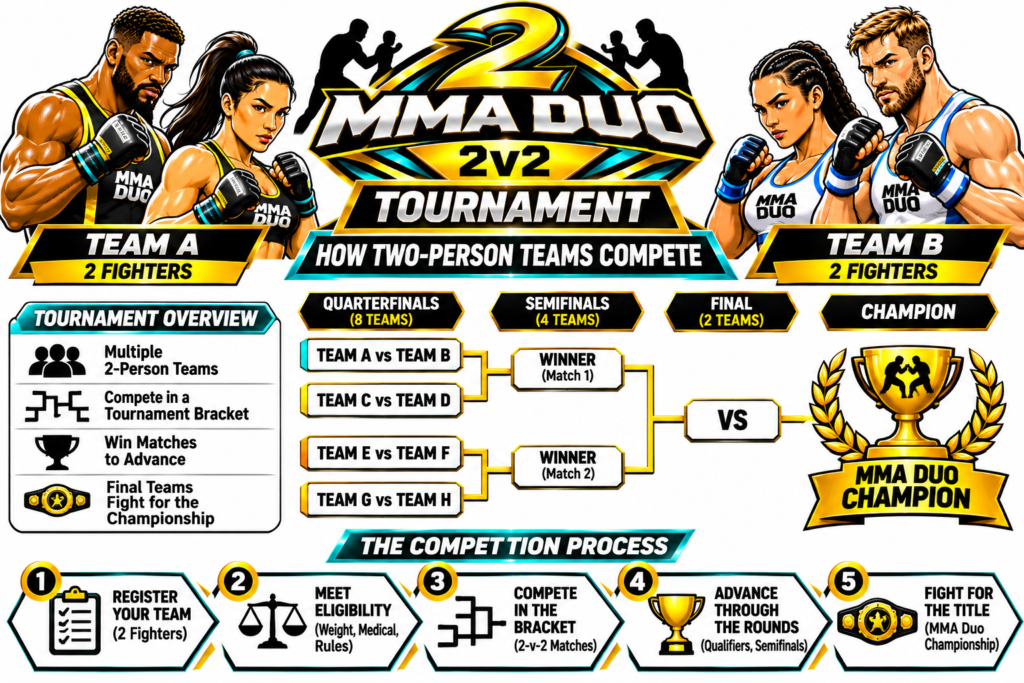
For example, an eight-team tournament could follow this structure:
Opening Round:
- Match 1: Team A vs. Team B
- Match 2: Team C vs. Team D
- Match 3: Team E vs. Team F
- Match 4: Team G vs. Team H
Semifinal Round:
- Semifinal 1: Winner of Match 1 vs. Winner of Match 2
- Semifinal 2: Winner of Match 3 vs. Winner of Match 4
Championship Final:
- The two semifinal winners compete for the MMA Duo tournament championship.
This structure creates a clear path from the opening matches to the final.
It also makes it easier for spectators to follow the tournament and understand which teams remain in contention.
4. Should MMA Duo Tournaments Use Single or Double Elimination?
Organizers could choose between several tournament structures.
The most suitable option would depend on the number of teams, available competition time, and event budget.
Single-Elimination Tournament
In a single-elimination tournament, a team must win each match to remain in the championship.
Advantages include:
- Simple tournament organization.
- Fewer matches required.
- Easy-to-understand brackets.
- A clear path to the championship final.
- Shorter event schedules.
The disadvantage is that a team is eliminated after one loss.
Double-Elimination Tournament
A double-elimination format gives teams another opportunity after their first loss.
Teams move into a secondary bracket after losing their opening match. A second loss results in elimination.
Potential advantages include:
- More competition opportunities for participating teams.
- Reduced impact of one early loss.
- Additional matchups for spectators.
- More opportunities to evaluate team performance.
However, double elimination requires additional matches and a more complicated schedule.
Round-Robin Tournament
A round-robin format allows every team to compete against several or all other teams in its group.
Teams accumulate results according to the published competition rules.
The highest-ranked teams could then advance to a championship round.
This approach offers more match experience but requires considerably more event time.
5. How Would Teams Qualify for an MMA Duo Championship?
Before entering a tournament, teams would need to meet the promotion’s eligibility requirements.
A qualification system could help ensure that competitors are properly prepared and matched.
Possible entry requirements include:
- Team registration: Both fighters must register together as an official team.
- Age eligibility: Competitors must meet the event’s minimum age requirements.
- Medical clearance: Fighters must satisfy the required medical examinations.
- Experience requirements: Organizers could establish appropriate experience levels for different divisions.
- Weight requirements: Both competitors must meet the tournament’s team or individual weight regulations.
- Licensing: Fighters must meet applicable licensing and athletic commission requirements.
- Team identification: Each team should have clearly distinguishable uniforms or approved fight equipment.
Promotions could also invite established teams or organize qualifying events.
A qualification system would give new teams an opportunity to compete while helping organizers maintain consistent entry standards.
Related reading: MMA Duo Fighter Roles: How Two Teammates Work Together
6. Should MMA Duo Tournaments Have Different Weight Divisions?
Weight divisions could be an important part of organizing a fair MMA Duo championship.
Organizers would need to determine whether teams are matched according to the combined weight of both fighters or whether each teammate must meet an individual weight limit.
Possible approaches include:
- Combined team weight: Both fighters’ weights are added together to establish the team’s division.
- Individual weight limits: Each teammate must meet a separate weight requirement.
- Matched team divisions: Teams are paired according to similar combined weights and approved eligibility requirements.
For example, a promotion could establish a lightweight team division and a heavier team division.
However, combined weight alone may not guarantee a fair matchup. Two teams could have identical combined weights but very different individual fighter sizes.
Organizers should consider individual weight differences, experience, and other relevant matching factors.
Clear weight regulations would help prevent disputes before competition begins.
7. How Would Teams Advance After Each Match?
The advancement process depends on the tournament format.
In a single-elimination competition, the winning team moves into the next round while the losing team leaves the championship bracket.
In a round-robin competition, advancement could depend on accumulated results and published ranking criteria.
A tournament organizer should establish:
- How match winners are determined.
- Whether both teammates must remain active for a team to advance.
- How an injured or unavailable fighter affects team eligibility.
- Whether replacement fighters are permitted.
- How draws and disputed results are handled.
- How teams are matched in subsequent rounds.
These decisions should be included in the official tournament regulations.
Read more: How Is an MMA Duo Fight Scored? Understanding 2-on-2 Judging
8. How Should MMA Duo Tournament Matches Be Scheduled?
Scheduling is another important part of organizing a successful tournament.
Unlike a competition involving individual athletes, an MMA Duo tournament must consider the recovery requirements of both members of each team.
Organizers need to avoid scheduling teams too close together, particularly when competitors have completed physically demanding matches.
Important scheduling considerations include:
- Recovery time: Teams should receive adequate recovery between matches.
- Medical evaluations: Fighters should receive appropriate assessments following demanding contests.
- Event duration: The number of matches must fit the available event schedule.
- Team availability: Both registered competitors must be available for their scheduled contests.
- Fair scheduling: No team should receive an unreasonable advantage through scheduling decisions.
- Emergency procedures: Organizers should have plans for injuries and unexpected withdrawals.
For a larger championship, opening matches could take place over several days, with semifinals and finals scheduled separately.
This could provide additional recovery time and create more opportunities to promote the championship.
9. Could MMA Duo Have a Championship Belt?
A championship belt could give an MMA Duo tournament a recognizable identity.
Instead of awarding an individual title to one fighter, the promotion could recognize both teammates as the official championship team.
Possible championship awards include:
- Team championship belt: Both teammates are recognized as members of the championship team.
- Individual championship medals: Each fighter receives an award recognizing their contribution.
- Tournament trophy: The winning team receives a permanent event trophy.
- Defending champions: The winning team could be invited to defend its title against future challengers.
A team championship belt could become one of the most recognizable symbols of the MMA Duo format.
It would also create a different type of championship identity compared with traditional individual MMA titles.
10. What Happens If a Team Cannot Continue in the Tournament?
Unexpected injuries and other circumstances can affect a team’s ability to continue.
Because MMA Duo requires two registered fighters, losing one teammate could create a difficult situation.
Tournament regulations should explain how these circumstances are handled.
Possible situations include:
- Injury before a match: A team may be withdrawn if one competitor cannot safely participate.
- Injury during a match: The referee and medical personnel determine whether the affected fighter can continue.
- Withdrawal between rounds: The organizer applies the published withdrawal and advancement rules.
- Replacement fighters: A promotion could allow an approved reserve competitor if its regulations permit.
- Disqualification: A team may be removed from the competition following a disqualifying violation.
These situations should be addressed before the tournament begins.
A promotion must also explain whether an opponent advances automatically when another team withdraws.
Related reading: MMA Duo Fighter Safety: How Could Two-Person Teams Be Protected?
11. Could MMA Duo Have International Tournaments?
MMA Duo could potentially develop into an international team competition.
Promotions could organize events featuring teams from different countries, gyms, or professional organizations.
An international tournament could include:
- Regional qualifying competitions.
- National team championships.
- Invitational tournaments.
- International team matchups.
- Annual championship events.
Different promotions could also organize their own competitions under clearly published rules.
For international tournaments to operate consistently, organizers would need to address fighter eligibility, medical requirements, weight divisions, officiating standards, and competition regulations.
An international championship could give teams an opportunity to represent their gyms and compete against athletes from different backgrounds.
12. Frequently Asked Questions About MMA Duo Tournaments
How many fighters compete in an MMA Duo tournament match?
Four fighters participate in a standard MMA Duo match. Two competitors represent each team.
How many teams can enter an MMA Duo tournament?
The number depends on the organizer. Possible tournament sizes include four, eight, sixteen, or more teams.
How do teams advance in an MMA Duo tournament?
In a single-elimination format, winning teams advance to the next round. Other formats may use accumulated results or group rankings.
Can an MMA Duo tournament use double elimination?
Yes. Organizers could use double elimination, allowing a team to remain in the competition after its first loss.
Do MMA Duo teams need to have the same combined weight?
Weight requirements depend on the promotion. Organizers could use combined team weight, individual weight limits, or other matching requirements.
Can a team replace an injured fighter during a tournament?
That depends on the published regulations. A promotion could permit an approved reserve fighter or require the team to withdraw.
Could MMA Duo have an official championship belt?
Yes. A promotion could award a team championship belt recognizing both members of the winning team.
Could MMA Duo tournaments become international competitions?
Yes. Promotions could organize regional, national, and international events featuring two-person teams.
Is there one universal MMA Duo tournament format?
No. Tournament structures can vary between promotions. Organizers must establish their own brackets, eligibility requirements, match rules, and advancement procedures.
Conclusion:
MMA Duo Tournaments Could Create a New Type of Team Championship
MMA Duo tournaments introduce a different way to organize mixed martial arts competition.
Instead of individual fighters competing for separate titles, two-person teams work together to advance through a championship.
An eight-team single-elimination tournament could provide a straightforward starting point. Larger events could introduce double elimination, round-robin groups, regional qualifying competitions, and international championships.
Successful tournament organization would require clear registration procedures, fair team matching, appropriate recovery periods, consistent rules, and reliable officiating.
The championship structure should also recognize both teammates as contributors to the team’s success.
MMA Duo could create a new championship opportunity in which two fighters compete together, advance together, and earn recognition as one winning team.
Visit the MMA Trio homepage to explore more articles about MMA Duo and MMA Trio rules, strategy, training, and team-based combat sports.