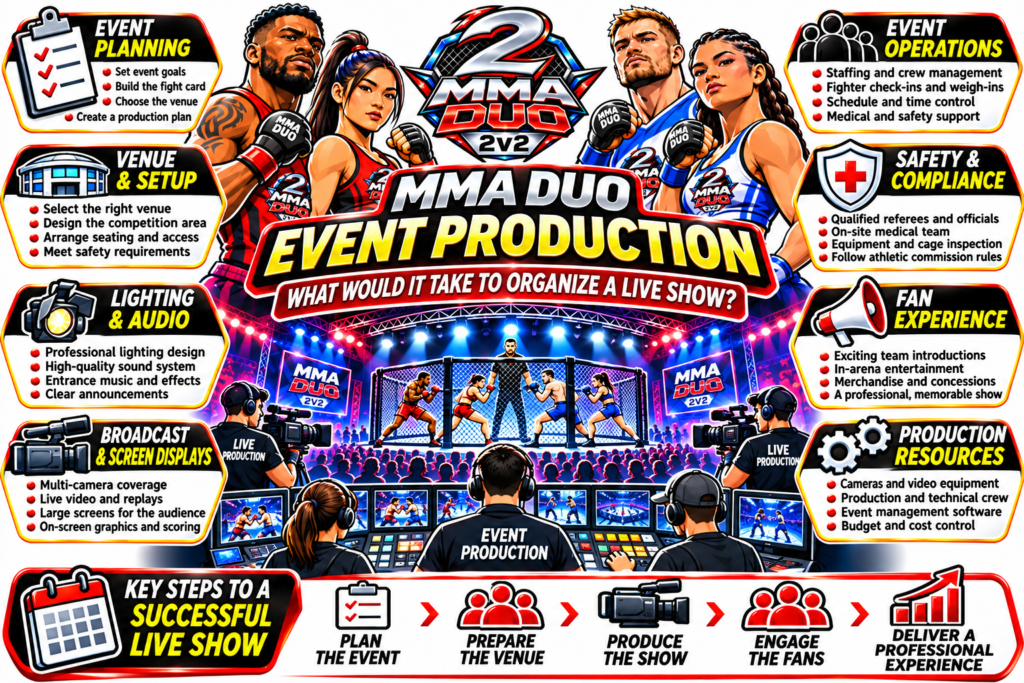
What Would It Take to Organize a Live Show?
Introduction: Bringing an MMA Duo Event to Life
What would it take to organize a professional MMA Duo live event?
A successful combat sports event requires much more than arranging two teams to compete. Behind every live competition is a production operation involving venue preparation, fighter coordination, officials, medical personnel, technical equipment, event scheduling, and staff management.
MMA Duo introduces a team-based approach to mixed martial arts in which two fighters compete together against another two-person team. Organizing this type of competition requires careful planning to ensure that the event runs smoothly and that athletes, officials, and spectators are properly accommodated.
From preparing the competition area to coordinating the final championship presentation, every part of the production process matters.
This article explores the major steps involved in organizing an MMA Duo live show and the equipment, personnel, facilities, and planning required to make it happen.
1. Select the Right Event Venue
The venue is one of the first decisions an MMA Duo event organizer must make.
The facility needs enough space for the competition area, fighter preparation areas, officials, medical personnel, production equipment, and spectators.
Possible venues include:
– Indoor sports arenas.
– Convention centers.
– Existing combat sports facilities.
– Multi-purpose sports halls.
– Large athletic facilities.
– Approved event venues.
Organizers should evaluate several factors before selecting a location:
– Available floor space.
– Ceiling height.
– Seating capacity.
– Accessibility.
– Parking availability.
– Emergency exits.
– Electrical capacity.
– Restroom facilities.
– Athlete preparation areas.
– Medical access.
A smaller venue could be appropriate for an initial event, while larger facilities could accommodate future competitions.
The venue should also meet applicable building, fire, accessibility, and event safety requirements.
2. Prepare the Competition Area
The competition area is the centerpiece of an MMA Duo event.
Unlike a regular sporting event where spectators can focus on one competitor, a 2-on-2 competition involves four fighters participating in the same match.
The competition space must be designed around the approved rules and format.
Important considerations include:
– Appropriate competition dimensions.
– Properly installed fencing or barriers.
– Secure flooring and padding.
– Clearly identified competition boundaries.
– Safe entry and exit points.
– Adequate lighting.
– Space for referees and officials.
– Access for medical personnel.
Organizers must work with qualified competition officials and relevant regulatory authorities to determine the appropriate setup.
The layout should allow officials to monitor the action and medical personnel to reach competitors when necessary.
The competition area should be inspected before every event.
3. Coordinate Fighters and Competing Teams
Fighter coordination is especially important because MMA Duo competitions involve two-person teams.
Event organizers must ensure that every participating athlete knows when and where to report, which team they represent, and what preparations are required before competition.
Important responsibilities include:
– Confirming fighter participation.
– Verifying team rosters.
– Checking required documentation.
– Coordinating weigh-ins when applicable.
– Scheduling medical examinations.
– Confirming competition eligibility.
– Providing event schedules.
– Organizing fighter check-in.
– Assigning preparation areas.
Each team should receive clear instructions about arrival times, warm-up procedures, equipment requirements, and competition schedules.
Matching team uniforms could also help officials, spectators, and production personnel identify the competing teams.
For example, one team could wear matching red uniforms while its opponents wear matching blue uniforms.
4. Organize Referees and Competition Officials
A professional MMA Duo event requires qualified officials who understand the approved competition format.
Because two fighters compete on each team, officials must be prepared to monitor the actions of multiple competitors.
Event organizers should coordinate:
– Referee assignments.
– Judge assignments.
– Official weigh-in procedures.
– Competition rule briefings.
– Scorekeeping arrangements.
– Penalty procedures.
– Stoppage protocols.
– Official reporting procedures.
Officials should receive clear instructions before the event begins.
The competition format must establish how referees monitor team interactions, recognize fouls, stop unsafe situations, and determine when a match should be interrupted.
The number of officials and their positions should be established through the applicable competition rules and regulatory requirements.
Read More: MMA Duo 2-v-2 Referees: How Could Officials Control a 2-on-2 Fight?
5. Arrange Medical Services and Emergency Support
Medical support should be part of the event production plan from the beginning.
Combat sports carry physical risks, and an event involving multiple competitors requires careful medical coordination.
Potential medical arrangements include:
– Qualified ringside medical professionals.
– First-aid personnel.
– Emergency medical response procedures.
– Ambulance access when required.
– Medical examination facilities.
– Designated treatment areas.
– Emergency communication systems.
– Procedures for fighter removal and transport.
Organizers should coordinate with appropriate medical providers and regulatory authorities before the event.
The medical team should know the venue layout, emergency exits, ambulance access points, and competition schedule.
Medical personnel must also have a clear understanding of their responsibilities if multiple fighters require attention.
6. Install Lighting, Sound, and Production Equipment
Professional production equipment can help transform a basic competition into an organized live sporting event.
Lighting should provide sufficient visibility throughout the competition area while allowing spectators to see the action clearly.
Sound equipment should allow organizers to communicate announcements, introductions, and important event information.
Potential production equipment includes:
– Arena lighting systems.
– Microphones.
– Speakers.
– Audio mixing equipment.
– Video displays.
– Scoreboards.
– Production computers.
– Communication headsets.
– Backup power equipment.
– Event recording equipment.
A production manager should coordinate technical setup and test the equipment before spectators enter the venue.
Backup equipment and contingency procedures are also important in case technical problems occur during the event.
7. Build a Professional Event Production Team
Organizing an MMA Duo event requires people with different responsibilities.
A production team could include:
– Event director.
– Event production manager.
– Competition coordinator.
– Fighter check-in personnel.
– Technical production staff.
– Lighting technicians.
– Audio technicians.
– Camera operators.
– Stage and floor managers.
– Security personnel.
– Medical coordinators.
– Venue operations staff.
– Administrative personnel.
Smaller events may require some employees to handle multiple responsibilities.
However, every important task should have an assigned person responsible for completing it.
A clear chain of communication can prevent confusion when unexpected situations arise.
8. Create a Detailed Event Schedule
A detailed schedule helps ensure that every part of the event takes place in the correct order.
Organizers should prepare a production schedule covering the period before, during, and after the competition.
A sample event-day schedule could include:
– Morning: Venue inspection and equipment setup.
– Late morning: Production testing and staff briefing.
– Early afternoon: Fighter check-in and required examinations.
– Afternoon: Official meetings and final preparations.
– Before opening: Security inspection and spectator entry preparation.
– Event opening: Announcements and team introductions.
– Competition period: Scheduled matches and tournament activities.
– Event conclusion: Final results and award presentations.
– After the event: Equipment breakdown and venue inspection.
Actual times would depend on the number of teams, competition format, venue requirements, and applicable regulations.
Organizers should also allow additional time for unexpected delays.
9. Coordinate Video Production and Broadcasting
Video production could allow MMA Duo events to reach audiences who cannot attend in person.
Even when an event is initially intended for a live audience, organizers may want to record competitions for highlights, interviews, promotional material, and future broadcasting opportunities.
Production requirements could include:
– Multiple camera positions.
– Camera operators.
– Video recording equipment.
– Audio recording.
– Commentary microphones.
– Video switching equipment.
– Replay capabilities.
– Graphics and score displays.
– Internet connectivity.
– Video storage and backup systems.
The camera layout should provide useful views of the entire competition area.
Because two-person teams compete simultaneously, camera operators and directors must be prepared to capture important action involving both teammates.
Related Article: MMA Duo Broadcasting: How Could 2-on-2 Fights Be Televised?
10. Manage Security and Crowd Operations
A live sporting event requires an organized security operation.
Security personnel should understand the venue layout, access restrictions, emergency procedures, and responsibilities of different staff members.
Important security arrangements include:
– Spectator entry checkpoints.
– Restricted fighter areas.
– Official and staff credentials.
– Emergency evacuation procedures.
– Crowd management.
– Protection of competition equipment.
– Access control for production areas.
– Coordination with venue security.
Organizers should also establish procedures for handling disruptive behavior, medical emergencies, and unexpected crowd situations.
The objective is to provide a safe environment for athletes, employees, officials, and spectators.
11. Prepare the Venue Before Opening
Before spectators arrive, the production team should complete a comprehensive inspection.
This final preparation stage helps identify problems before the event begins.
The inspection could include:
– Competition area inspection.
– Equipment safety checks.
– Lighting and sound tests.
– Scoreboard testing.
– Medical station preparation.
– Emergency exit inspections.
– Security briefings.
– Staff attendance checks.
– Fighter preparation area inspections.
– Communication system testing.
Organizers should conduct a final production meeting to confirm that all departments are ready.
Any outstanding safety or technical problems should be addressed before competition begins.
12. Manage Event Changes and Unexpected Problems
Even carefully planned sporting events can experience unexpected problems.
A fighter could withdraw, equipment could malfunction, or a competition could be delayed.
An effective production plan should include contingency procedures.
Potential situations include:
– Fighter withdrawals.
– Medical emergencies.
– Technical equipment failures.
– Lighting or electrical problems.
– Delayed competitions.
– Venue access problems.
– Weather-related disruptions.
– Broadcasting interruptions.
Organizers should identify who has authority to make important decisions and how information will be communicated.
A backup schedule, replacement equipment, and emergency contacts could help reduce disruptions.
The priority should always be athlete safety and compliance with applicable competition requirements.
13. Complete the Event Breakdown and Post-Event Review
Event production does not end when the final competition finishes.
The production team must safely remove equipment, restore the venue, complete administrative tasks, and review the event.
Post-event responsibilities could include:
– Removing temporary equipment.
– Packing production equipment.
– Inspecting the competition area.
– Returning rented equipment.
– Completing official reports.
– Recording competition results.
– Reviewing incidents.
– Collecting staff feedback.
– Reviewing production problems.
– Preparing improvements for future events.
A post-event meeting could help identify which procedures worked well and which areas need improvement.
This information could become valuable when organizing future MMA Duo competitions.
Frequently Asked Questions About MMA Duo Event Production
What is required to organize an MMA Duo live event?
Organizers would need an appropriate venue, a properly prepared competition area, participating fighters, qualified officials, medical support, production equipment, security personnel, and a detailed event schedule.
What type of venue could host an MMA Duo event?
Potential venues include indoor sports arenas, convention centers, combat sports facilities, multi-purpose sports halls, and other approved sporting venues.
What equipment would an MMA Duo event need?
Potential equipment includes competition fencing, appropriate flooring and padding, lighting, microphones, speakers, scoreboards, video displays, cameras, communication equipment, and medical supplies.
How many employees would be needed to produce an MMA Duo event?
Staffing would depend on venue size, the number of competitors, event complexity, and applicable regulatory requirements. Smaller events could use a compact production team, while larger events would require more specialized personnel.
Why is event scheduling important?
A detailed schedule helps coordinate fighters, officials, medical personnel, production staff, technical equipment, and venue operations. It also helps prevent unnecessary delays.
Could MMA Duo events be recorded and streamed online?
Yes. With suitable cameras, audio equipment, production personnel, and distribution arrangements, organizers could record competitions and potentially offer live or recorded online coverage.
Conclusion: Turning an MMA Duo Competition Into a Professional Live Event
Organizing an MMA Duo live show would require careful coordination across several departments.
The venue, competition area, fighter preparation, officials, medical support, lighting, sound, security, and video production must work together.
Because two-person teams compete simultaneously, organizers would also need to ensure that the competition layout, officiating procedures, and production arrangements are appropriate for the format.
A successful event would depend on preparation, communication, qualified personnel, and attention to safety.
Starting with manageable events could allow an MMA Duo organization to develop its production procedures, identify problems, and improve its operations over time.
With professional planning and reliable event management, MMA Duo could create a repeatable live-event production system capable of supporting larger competitions in the future.
To learn more about MMA Duo and the future of 2-on-2 mixed martial arts, click here to explore MMA Duo.